
Dengue fever is a mosquito-borne viral infection that has become one of the most serious public health challenges in tropical and subtropical regions especially across Asia and Africa.
According to the World Health Organization (WHO), about 390 million infections occur every year, and nearly half of the world’s population is at risk.
Approximately 75% of global dengue exposure occurs in the Asia-Pacific region, mainly in urban areas.
Why Dengue Spreads So Fast
1. Rapid viral mutation: The virus developed into hybrid strains, making treatment and difficult to vaccine development.
2. Climate change: Rising temperatures and unpredictable rainfalls increase mosquito breeding.
3. Urbanization: Stagnant water in cities promotes Aedes mosquito habitats.
4. Global travel: Infected individuals can spread the virus to new locations.
Etiopathogenesis (How the Virus Acts in the Body)
Affects all age groups, especially children and young adults.
The virus replicates in macrophages, key immune system cells.
It causes inflammation, capillary leakage, and bleeding tendencies.
Transmitted by Aedes aegypti and Aedes albopictus mosquitoes.
Belongs to the Flaviviridae family with four serotypes: DEN-1, DEN-2, DEN-3, DEN-4.
Incubation period: 4–10 days after a mosquito bite.
Mosquito activity: Mostly during daytime.
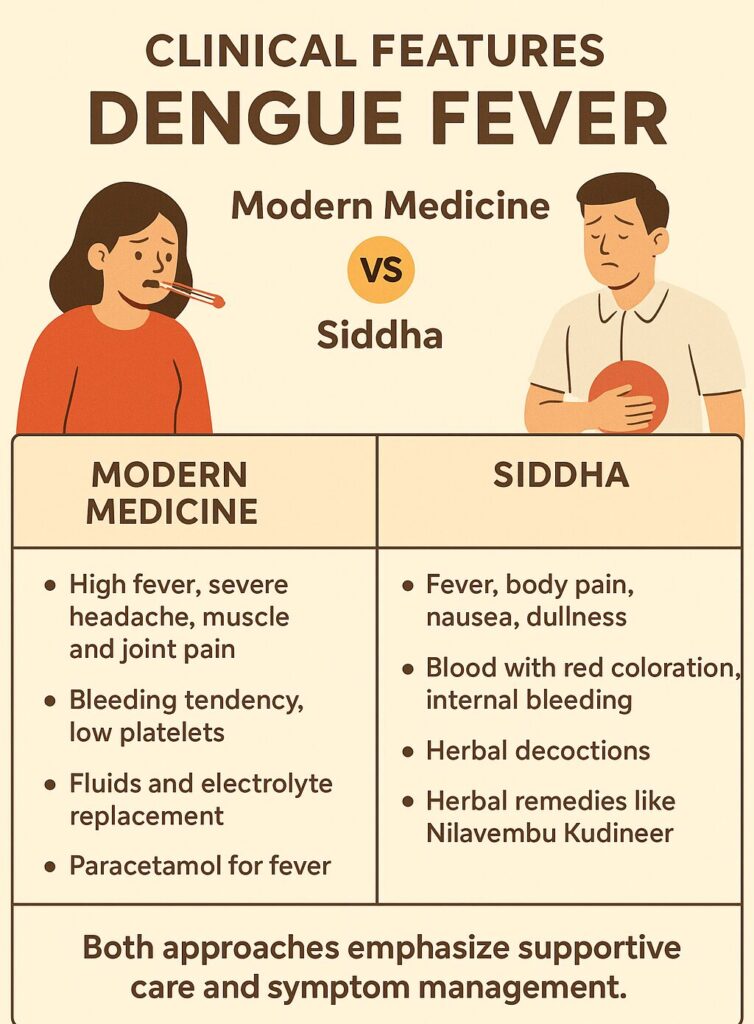
Clinical Features of Dengue Fever
The clinical presentation of dengue varies from mild fever to severe, life-threatening forms.
Dengue into three main stages:
1. Dengue Fever (Classical/Uncomplicated Dengue)
Onset: Sudden, incubation after 4–7 days.
Features:
* Sudden high-grade fever (up to 104°F)
* Severe headache and pain behind the eyes
* Muscle, bone, and joint pain (“break-bone fever”)
* Loss of appetite and nausea
* Skin rash (appears on day 3–5)
* Slight bleeding from gums or nose in some cases
2. Dengue Hemorrhagic Fever (DHF)
It occurs when the virus causes blood vessel damage and leakage.
*Severe abdominal pain
*Persistent vomiting
*Bleeding under the skin, from gums or nose
*Enlarged liver (hepatomegaly)
* Low platelet count (thrombocytopenia)
* Fluid accumulation in chest or abdomen
3. Dengue Shock Syndrome (DSS)
A severe form leading to circulatory failure.
*Cold, clammy skin
*Restlessness, low blood pressure
*Weak pulse and reduced urine output
*Organ failure if not treated immediately
Symptoms
1. Febrile Phase
- High fever
- Body pain, eye pain
- Nausea and vomiting
- Mild rashes
2. Critical Phase
- Platelet count drops
- Bleeding tendencies
- Fluid leakage
- May develop DHF or DSS
3. Recovery Phase
- Fever subsides
- Appetite returns
- Rash reappears temporarily (“white islands in a sea of red” pattern)
Diagnosis
1. NS1 Antigen Test: Detects early infection (Day 1–5)
2. IgM/IgG Antibody Test: Confirms infection (Day 5 onwards)
3. Complete Blood Count (CBC): Tracks platelets and hematocrit levels.
WHO 2024 Warning Signs
Any warning signs appear immediately going to near the hospital
- Abdominal pain or tenderness
- Persistent vomiting
- Fluid accumulation (ascites, pleural effusion)
- Bleeding or bruising
- Lethargy or restlessness
- Liver enlargement
- Low platelet count
Medical Treatment
No specific antiviral medicine for dengue.
Treatment focuses on hydration, monitoring, and symptomatic relief only.
1. Paracetamol for fever (avoid aspirin or ibuprofen)
2. Oral rehydration fluids: water, tender coconut, soups, ORS
3. Frequent blood tests to monitor platelet levels
4. IV fluids for severe dehydration.
5. Blood transfusion if major bleeding occurs.
(WHO 2024 Updated)Early IV rehydration therapy has significantly reduced dengue-related mortality, especially in children under 15 years.
Siddha & Herbal Remedies (AYUSH-Approved)
The Central Council for Research in Siddha (CCRS) recommends several traditional medicines with proven benefits in dengue management.
1.Nilavembu Kudineer (Andrographis paniculata) 30 ml twice daily for 7 days Reduces fever, boosts immunity, antiviral action.
2. Papaya Leaf Juice 10 ml twice daily megakaryocyte activity, increasing platelet count naturally.
3. Ada thodai Leaf Juice + Honey 10–20 drops twice controls internal bleeding.
4. Veppilai Chooranam (Neem powder) 1 g daily Antiviral against DENV-2.
5. Amukkara Chooranam (Ashwagandha) 2 tablets twice daily Strengthens body, improves blood count.
Prevention
1. Since dengue has no vaccine yet. prevention is essential.
2. Mosquito Control & Lifestyle Habits
3. Remove stagnant water in and around homes.
4. Cover water containers and change water regularly.
5. Use mosquito nets, coils, and repellents.
6. Wear full-sleeved clothing during daytime.
7. Keep the surroundings clean and dry.
8. medical care immediately when dengue symptoms appear.
When to see a doctor
- Continuous vomiting
- Severe abdominal pain
- Bleeding nose and gums
- Drowsiness paleskin
- Low urine output .
Siddha Perspective:
According to Siddha texts, dengue corresponds to “Pitha Suram”, it is caused by an imbalance in Pitham (fire element) among the body’s three humors Vatham, Pitham, Kabam.
From the classical text Suravakadam:
செய்யும் பித்த சுரந்தனிற்
ரிகழும் குணங்கேள் நாவுலரும்
பெய்யும் சிறுநீர் சிவந்திருக்கும்
பிதற்றும் சத்தி ஒக்காளம்…
Meaning:
Symptoms include fever with dryness of mouth, red urine, nausea, vomiting, bitter taste, body ache, ulcers in the mouth, dysentery, yellowish eyes (jaundice), and alternating chills and fever. It closely matches modern dengue clinical features.
Conclusion
Dengue fever can be controlled and managed effectively when we combine modern medicine and traditional Siddha medicine. Health is balance. Our body heals naturally when supported with rest, right food, and proper care.Be happy

Dr. Augastina B.S.M.S., PGDY, is a passionate Siddha Doctor with a heart of gold. She believes in healing one step at a time. In her writing, you’ll find not just knowledge, but genuine care and a holistic approach to health and well-being.